

If you’ve ever been part of a property discussion in North India, you already know how confusing land measurements can be. One neighbor talks in gaj, another one mentions square feet, and a broker may even throw in units like marla or kanal for extra chaos. It’s no surprise that thousands of people search “Gaj Into Square Foot” every month because they simply want clarity before buying or evaluating property. Land is a big investment, and having the right understanding from the start helps people make smarter decisions.
Over the past decade, working around real estate documentation, I’ve seen how frequently small miscalculations create big misunderstandings. A family negotiating a plot price once believed 1 gaj was equal to 9 square feet, while the seller insisted it was 3 square feet. Just imagine the difference that makes in pricing. That’s why a clear and accurate explanation matters. And when you break the topic down, it’s actually extremely simple to understand.
This blog walks you through every detail: what gaj means, how to convert gaj to square feet, helpful examples, common doubts, conversions like 1 gaj, 100 gaj, and 200 gaj, and even yard-to-square-foot calculations. By the time you finish reading, you’ll be able to handle any gaj to sq ft conversion on your own with complete confidence.
What Is Gaj?
Although it feels like a modern unit because of its popularity in real estate, gaj has been around for centuries. It originally referred to the length of a person’s arm span, and over time, different regions standardized it as a measure of land area. Even today, gaj continues to be widely used in states like:
- Punjab
- Haryana
- Rajasthan
- Delhi
- Uttar Pradesh
- Uttarakhand
When people talk about small plots, home front setbacks, verandas, side passages, or extensions, they commonly use gaj. It’s familiar, easy to visualize, and easier to communicate in everyday conversations.
In formal documentation, square feet may take the lead, but during on-ground inspections or while negotiating, gaj still holds its value. This is why everyone buying or selling property in North India must understand how gaj relates to other units, especially square feet.
What Is a Square Foot?
A square foot is a globally recognized measurement of area, especially popular in construction, architecture, and real estate listings. One square foot is simply a square with each side measuring one foot.
Builders use square feet because it allows:
- Accurate blueprint planning
- Standardized pricing
- Easy comparison across projects
- Transparent advertisements
When you look at property brochures, floor plans, or loan documents, you’ll almost always find area written in square feet. This is why knowing the gaj to square feet conversion is crucial, even if your local conversations happen in gaj.
Basic Formula: How to Convert Gaj Into Square Feet
Let’s start with the simplest part.
The basic conversion formula is:
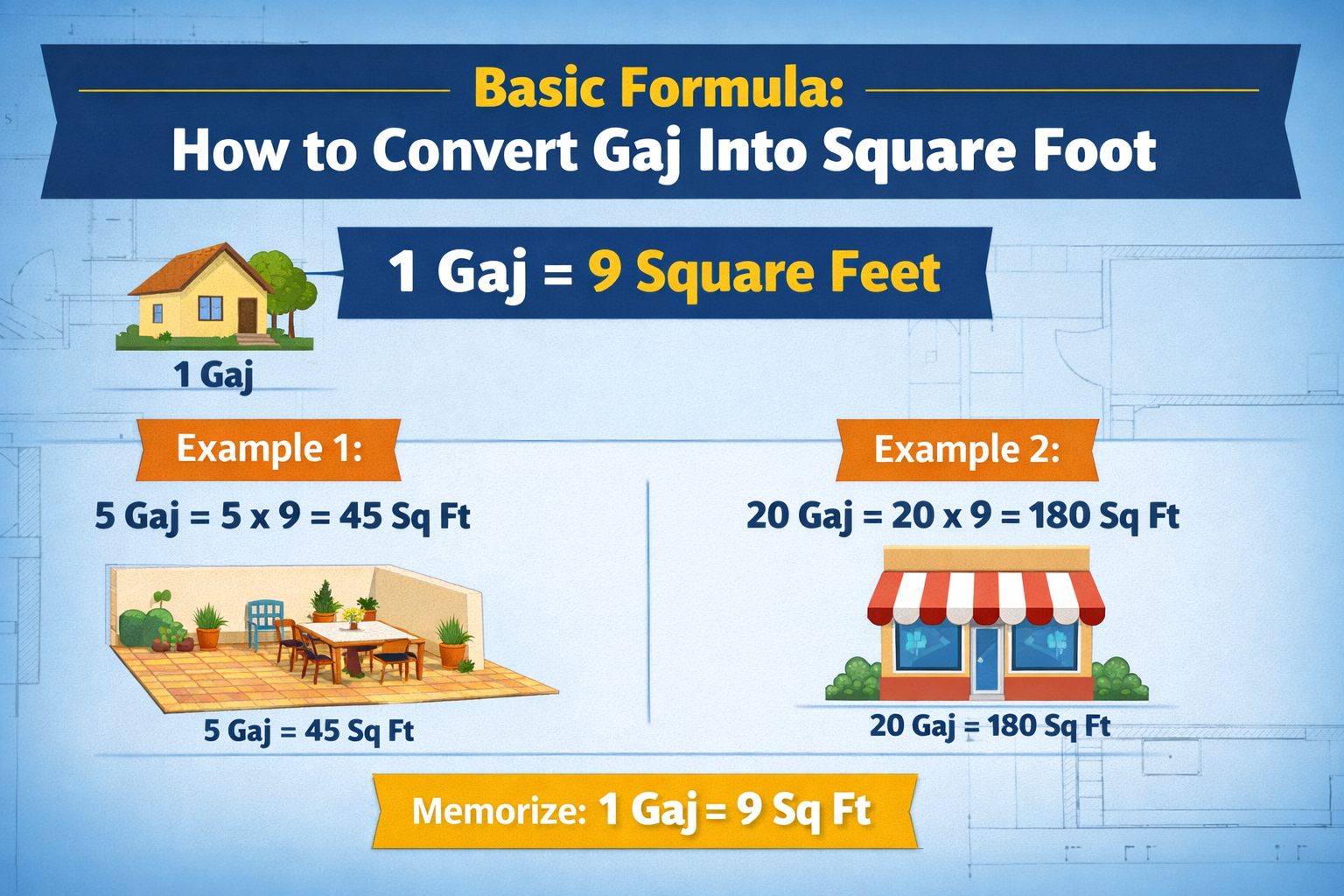
1 gaj = 9 square feet
Yes, it’s that straightforward.
But understanding how to apply this in real situations is where most people feel stuck. Let’s go step by step with simple scenarios so you can picture it clearly.
Example 1:
If someone says their courtyard is 5 gaj:
5 × 9 = 45 sq ft
Example 2:
A small shop measuring 20 gaj:
20 × 9 = 180 sq ft
Once you memorize that 1 gaj = 9 square feet, every other calculation becomes effortless.
This understanding will help you easily convert gaj to square feet in your daily life.
How Many Square Feet in 1 Gaj?
Many people ask the same question in two slightly different ways:
- How many square feet are in 1 gaj?
- How many square feet are there in 1 gaj?
Both questions point to the same answer:
1 gaj = 9 sq ft
Let’s look at a few examples for better clarity:
Example A:
1 gaj laundry area
= 9 sq ft
Example B:
1 gaj passage beside a house
= 9 sq ft
Example C:
1 gaj balcony extension
= 9 sq ft
Small measurements like these become much easier once you understand how the units match.
1 Gaj Into Square Feet – Practical Examples
Let’s go through real-life examples where homeowners commonly measure 1 gaj:
1. Boundary Adjustment
If your neighbor says, “Shift the fence by 1 gaj,”
They actually mean shifting by 9 square feet of area.
2. Building Permission Setback
If municipal rules require a 1-gaj open space on one side,
That means 9 sq ft must remain open.
3. Shop Counter Extension
If a shop owner extends the counter by 1 gaj,
He adds 9 sq ft of usable space.
4. Balcony Railing Push-out
In apartments, some people push the railing slightly ahead by 1 gaj,
Adding 9 sq ft extra.
Understanding these examples helps you evaluate small changes with better judgment.
100 Gaj Into Square Feet (With Reverse Calculation)
One of the most common search queries is related to 100 gaj plots.
100 gaj = 100 × 9 = 900 sq ft
So, a 100 gaj plot is exactly 900 square feet.
But many people also ask the reverse:
How many square feet are in 100 square feet?
If 1 gaj = 9 sq ft, then:
100 ÷ 9 = 11.11 gaj (approximately)
So, 100 sq ft equals a little over 11 gaj.
This reverse calculation is helpful when comparing builder floor plans or checking plot descriptions in village records.
200 Gaj Into Square Feet – Real-Life Case
Now, let’s understand a standard mid-size residential plot.
200 gaj = 200 × 9 = 1800 sq ft
So a 200 gaj plot measures 1800 square feet.
If someone sells half of it:
- Half of 200 gaj = 100 gaj
- Which equals 900 sq ft
This helps during shared inheritance cases, resale agreements, and boundary clarifications.
Yard Into Square Feet – Bonus Conversion
People often mix up yard with gaj because the words sound similar. But a yard refers to a linear measurement in English units.
1 yard = 3 feet (length)
1 square yard = 9 square feet (area)
Interestingly, this means:
1 gaj and 1 square yard both equal 9 square feet.
This is why many people assume gaj and yard are the same, although historical uses are different.
Example:
If someone measures a cloth shop area as 10 square yards:
10 × 9 = 90 sq ft
Understanding the yard conversion solves confusion while dealing with older property papers or British-era measurements still used in some markets.
Step-by-Step Guide: gaj to sq ft conversion
Here’s an easy checklist so you can calculate anywhere, anytime:
- Note down the gaj value.
- Multiply the number by 9.
- The result is the area in square feet.
- For reverse conversion, divide square feet by 9.
- Recheck values if you’re calculating for a large plot.
- Use a calculator to avoid errors during negotiations.
- If measurements are irregular in shape, break the plot into smaller rectangles.
- Add all areas together at the end.
Anyone can use these steps without technical knowledge.
Why Accurate Land Conversion Matters in Property Deals
Over the years, I’ve seen buyers lose money simply because they didn’t understand unit conversions. A slight mismatch of even 20 gaj means losing 180 sq ft, which is a big amount of space.
Accurate conversion helps you:
- Negotiate confidently
- Verify plot size before paying
- Avoid fraud in rural land deals
- Compare market rates correctly
- Understand construction drawings
- Communicate clearly with contractors
Real estate thrives on clarity. Even one wrong calculation can create major confusion between buyers and sellers.
Real Estate Buyer Tips
Whether you’re buying a plot or an apartment, these quick pointers help you stay sharp:
- Always measure the plot yourself or hire a surveyor.
- Compare both gaj and square feet values.
- Ask the seller for documentation showing area calculations.
- For older properties, verify the conversion used at the time of sale.
- Keep a conversion sheet handy during negotiations.
- Don’t rely solely on verbal measurements.
- Double-check all values in the property registry papers.
Accurate numbers create trust and prevent disputes.
Beverly Golf Avenue – Real Estate Insights You Can Trust
Real estate conversations often involve multiple units of measurement, from gaj to square feet to yards. Having reliable information makes your property decisions smoother. Beverly Golf Avenue provides clarity and transparency in every aspect of modern home buying, whether it’s understanding area measurements, evaluating usable spaces, or navigating documentation. Their content and resources help homebuyers feel informed and confident before making any major decision, especially when dealing with different land units.
This reliable approach is what helps people bridge the gap between traditional measurements and modern real estate practices.
Frequently Asked Questions
1. How many square feet are there in 1 gaj?
There are exactly 9 square feet in 1 gaj. This is the most widely accepted conversion across North India and is used for both residential and commercial areas.
2. How is gaj different from square feet?
Gaj is a traditional Indian unit, while square feet is a modern and internationally recognized unit. Both measure area, but square foot is used more in formal documents and builder projects.
3. What is the easiest method to convert gaj to square feet?
Simply multiply the number of gaj by 9. This single formula works for every size and every type of plot.
4. Is gaj still used in modern real estate transactions?
Yes, especially in states like Punjab, Haryana, Delhi, and Uttar Pradesh. Even if documents use square feet, local discussions often use gaj.
5. How many square feet are there in 100 square feet?
To find the value, divide 100 by 9. You’ll get approximately 11.11 gaj.
6. How accurate is the manual gaj to sq ft conversion?
If you use the correct formula and recheck calculations, manual conversion is highly accurate. Just ensure you’re multiplying or dividing by 9 properly.
7. Why do different states use different land units?
Different land units evolved historically, shaped by culture, agricultural practices, and British-era influences. Over time, some regions retained traditional units while others shifted to modern ones.
8. What is the best way to convert gaj to square feet for large plots?
For large land areas, it’s best to use a calculator or spreadsheet. Multiply the gaj value by 9 and recheck the final result to avoid errors during purchase agreements.
Final Thoughts
Understanding property measurements becomes much easier once you know the basic conversions and see how it works in day-to-day situations. Whether you’re calculating a balcony extension or evaluating a 200-gaj plot, the logic stays the same and helps you avoid costly misunderstandings. By now, the formula should feel familiar and simple enough for you to use without hesitation. And whenever you’re dealing with traditional units, knowing how to convert Gaj into square feet ensures clarity, confidence, and accuracy in every real estate discussion.