

If you’ve ever tried to understand land measurements in India, you’ve probably come across a mix of units: Bigha, Marla, Kanal, Acre, Cent, and Decimal. Out of all these, Decimal is one of those units that many people have heard of but aren’t fully familiar with. And that’s exactly why so many buyers, especially first-time ones, end up searching for One Decimal Land in Square Feet when they’re comparing plots or reviewing property papers. Whether you’re thinking of investing in farmland, a small residential plot, or even weighing the idea of buying luxury flats in Chandigarh, knowing this conversion gives you the upper hand. It helps you make sense of property sizes, negotiate confidently, and avoid getting misled by confusing numbers.
Understanding What a “Decimal” Really Means in Land Measurement
The term “Decimal” didn’t just appear randomly in India’s real estate culture. It has been used for generations, mainly in states like West Bengal, Bihar, Jharkhand, Assam, Tripura, and pockets of Odisha. When land records were prepared decades ago, officials needed a simple, uniform system for small parcels of land, especially agricultural ones. Decimal was the answer because it was easy to divide, easy to document, and easy for farmers to understand.
With modernization, cities gradually moved toward square feet and square meters, but rural and semi-urban regions continued with Decimal. That’s why so many people today still ask 1 decimal land how many square feet the dual-system problem is.
And because land documents often carry older terminology, knowing these conversions isn’t optional anymore. It’s essential.
Decimal has been used for generations, especially in eastern India. If you want to explore how Decimal compares with other traditional units, learn more about traditional land measurement units here.
So, How Much Is One Decimal in Square Feet?
Here’s the clear, no-confusion answer:
✔ 1 Decimal = 435.6 Square Feet
This number doesn’t change between states. It isn’t a rough estimate. It’s the accepted, officially used value.
The Simple Formula Behind the Conversion
If you want to convert Decimal into square feet:
Square Feet = Decimal × 435.6
A Few Quick Examples Using Realistic Numbers
To make the idea sink in, here are a few instant conversions:
- 1 Decimal → 435.6 sq ft
- 3 Decimal → 1,306.8 sq ft
- 5 Decimal → 2,178 sq ft
- 8 Decimal → 3,484.8 sq ft
- 10 Decimal → 4,356 sq ft
These are especially useful when you’re trying to visualize the size of a plot without physically visiting it. It also helps when you want to compare land sizes from different sellers who use different units.
If someone mentions one decimal in square feet, you now know the answer confidently.
How to Convert Decimal to Square Feet: A Step-by-Step, Beginner-Friendly Method
Instead of just memorizing numbers, here’s a simple process you can use every time.
STEP 1: Take the land size given in Decimal
For example: 7 Decimal.
STEP 2: Multiply it by 435.6
7 × 435.6 = 3,049.2 sq ft
STEP 3: Round only if necessary
Avoid rounding too early; it creates large errors for bigger plots.
Why People Use This Conversion?
Almost every cost in modern real estate, construction, valuation, taxation, and registry is calculated per square foot. Even if land is advertised in decimals, the math always circles back to square feet.
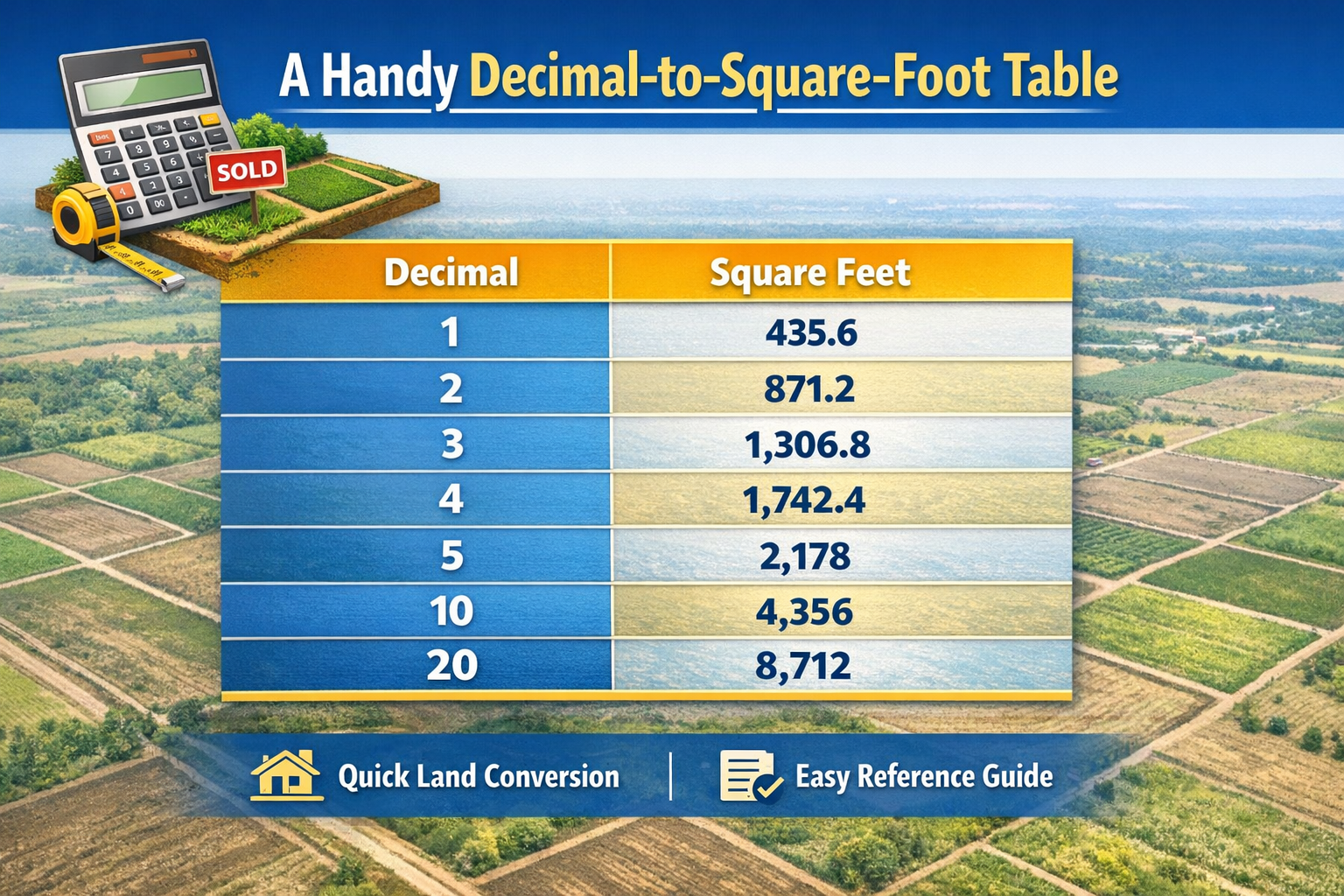
This is the kind of table people save in their phone gallery because it makes quick decisions much easier.
Why Understanding This Conversion Matters in Real Estate
You might think land measurement is a niche topic, but it influences real decisions. And not just when buying raw land, these calculations help even when evaluating the land share included in luxury flats or gated communities.
1. So You Don’t Overpay
Imagine land is being sold at ₹1,200 per sq ft.
If a seller claims that 10 Decimal means 6,000 sq ft instead of 4,356 sq ft, that’s a massive price difference. Without knowing the correct conversion, it’s easy to be misled.
2. For Comparing Two Different Properties
One property might be listed in Decimal, another in square feet. Without conversion, the comparison is impossible. This is often why people search 1 decimal land how many square feet when comparing options.
3. When You’re Choosing Between a Plot vs. Luxury Flats Chandigarh
If you’re deciding whether to buy a plot for future construction or invest in luxury flats Chandigarh, knowing how much land you’re actually getting helps evaluate long-term returns.
4. For Registry, Documentation & Bank Loan Processing
Banks check the area in sq ft while approving home or construction loans. Even if your property documents mention Decimal, conversions have to be accurate.
Real-Life Practical Scenarios Where You’ll Actually Use This Conversion
Let’s break down a few situations that people face in everyday property dealings.
This is also where many buyers again find themselves asking: How much is One Decimal Land in Square Feet? making it the right point to use the focus keyword naturally in the middle of this article.
Scenario 1: Buying a Compact Residential Plot
You find a 3.5 Decimal plot located inside a developing neighborhood.
3.5 × 435.6
= 1,524.6 sq ft
Now you can immediately understand how large your home could be.
Scenario 2: Agricultural Investment
Farmers often calculate cultivation area based on decimals.
If a farmer buys 15 Decimal:
15 × 435.6 = 6,534 sq ft
This helps them plan irrigation, fencing, seed requirements, and crop spacing.
Scenario 3: Buying Land for Investment
Let’s say you’re exploring land outside the city limits.
A 25-Decimal plot:
25 × 435.6 = 10,890 sq ft
Now you can easily compare its value against other investment options.
Scenario 4: Dividing Land in a Family Settlement
If a 40-Decimal ancestral plot needs equal distribution among four siblings, each gets:
40 ÷ 4 = 10 Decimal
→ 10 × 435.6 = 4,356 sq ft each
Conversions avoid disputes and ensure transparency.
Common Mistakes People Make While Converting Decimal to Sq Ft
Even though the math seems easy, mistakes happen more often than you’d think.
1. Approximating Instead of Using the Exact Figure
Rounding 435.6 to 436 or 430 can skew results heavily for large plots.
2. Mixing Up Local Units
Marla, Cent, Decimal, and Guntha are NOT interchangeable. One mistake can change thousands of square feet.
3. Assuming Decimal Is the Same Everywhere
Some regions have older systems, and local interpretation may vary. Always verify with the local revenue office.
4. Trusting Verbal Claims
Never rely on verbal statements from sellers. Always measure or verify officially.
5. Using Outdated Land Maps
Old maps often contain approximations or fragmented values.
Practical Tip:
Always cross-check using a surveyor tool or official calculator; your negotiation strength increases instantly.
Tips for Getting Land Measurements Right Every Single Time
Here’s what professionals, brokers, surveyors, and lawyers usually rely on:
✔ Use Government Land Measurement Tools
Most state websites now offer official conversion tools that are accurate.
✔ Hire a Licensed Surveyor
Surveyors have the right instruments, measuring chains, total stations, and GPS tools to give precise readings.
✔ Compare with the Registry Record Book
Registry documents never lie. Always match what the seller claims with the paperwork.
✔ Use Digital Maps & GIS Tools
Apps like Bhunaksha (state versions) and GIS-based tools show boundaries clearly.
✔ Don’t Rely on Approximations
Even a 100 sq ft miscalculation can change land value significantly.
✔ Take Photos and Create Your Own Reference Table
Many buyers create a personal cheat sheet to avoid confusion later.
FAQs
1. What is One Decimal Land in Square Feet?
One Decimal equals exactly 435.6 square feet. This conversion is standardized and widely used across multiple Indian states. Understanding this value helps buyers compare land listed in Decimal with properties measured in square feet.
2. Why do different regions use different land units?
India inherited various measurement systems from different kingdoms, cultures, and British-era surveys. That’s why units like Marla, Bigha, Cent, and Decimal vary regionally. Over time, square feet became the standard, but older systems still remain in use.
3. How do I verify land measurements before buying?
Always cross-check documents, hire a certified surveyor, compare boundaries with digital maps, and verify the total area through government platforms. This ensures there are no discrepancies between what’s on paper and what exists physically.
4. Is Decimal still used legally in India?
Yes. Many states still record land in Decimal, especially in rural and semi-urban regions. However, developers, architects, banks, and registrars mostly refer to square feet during valuation and documentation.
5. How does Decimal compare to Marla or Acre?
One Decimal is 1/100 of an Acre. It is smaller than Marla (which varies between states). Because the values differ across regions, conversions must always be checked correctly.
6. How can I calculate land value using square feet?
Once you convert the decimal into square feet, multiply the square-foot area by the current market rate per square foot. This gives the total price, making it easier to negotiate or estimate loan eligibility.
7. Why do buyers prefer square feet over Decimal today?
Square feet is widely accepted nationwide. It simplifies construction planning, loan processing, and builder documentation, making it practical compared to traditional units.
8. Is land measurement important when buying luxury flats in Chandigarh?
Yes. Even when buying luxury apartments, understanding land share, open areas, and the total land parcel helps you evaluate how strong your long-term investment will be. It also helps compare land-based investments with fully built projects.
Conclusion
Whether you’re looking at a compact residential plot, agricultural land, or even weighing the appeal of luxury flats, knowing how to convert One Decimal Land in Square Feet makes your decisions more informed. Accurate measurement gives you confidence, whether you’re negotiating prices, checking registry details, or simply comparing multiple property options. With this clarity, you can avoid misunderstandings, spot errors instantly, and ensure that every square foot you pay for is worth it. In a real estate market that values transparency, this knowledge serves as one of the strongest tools you can carry with you.